

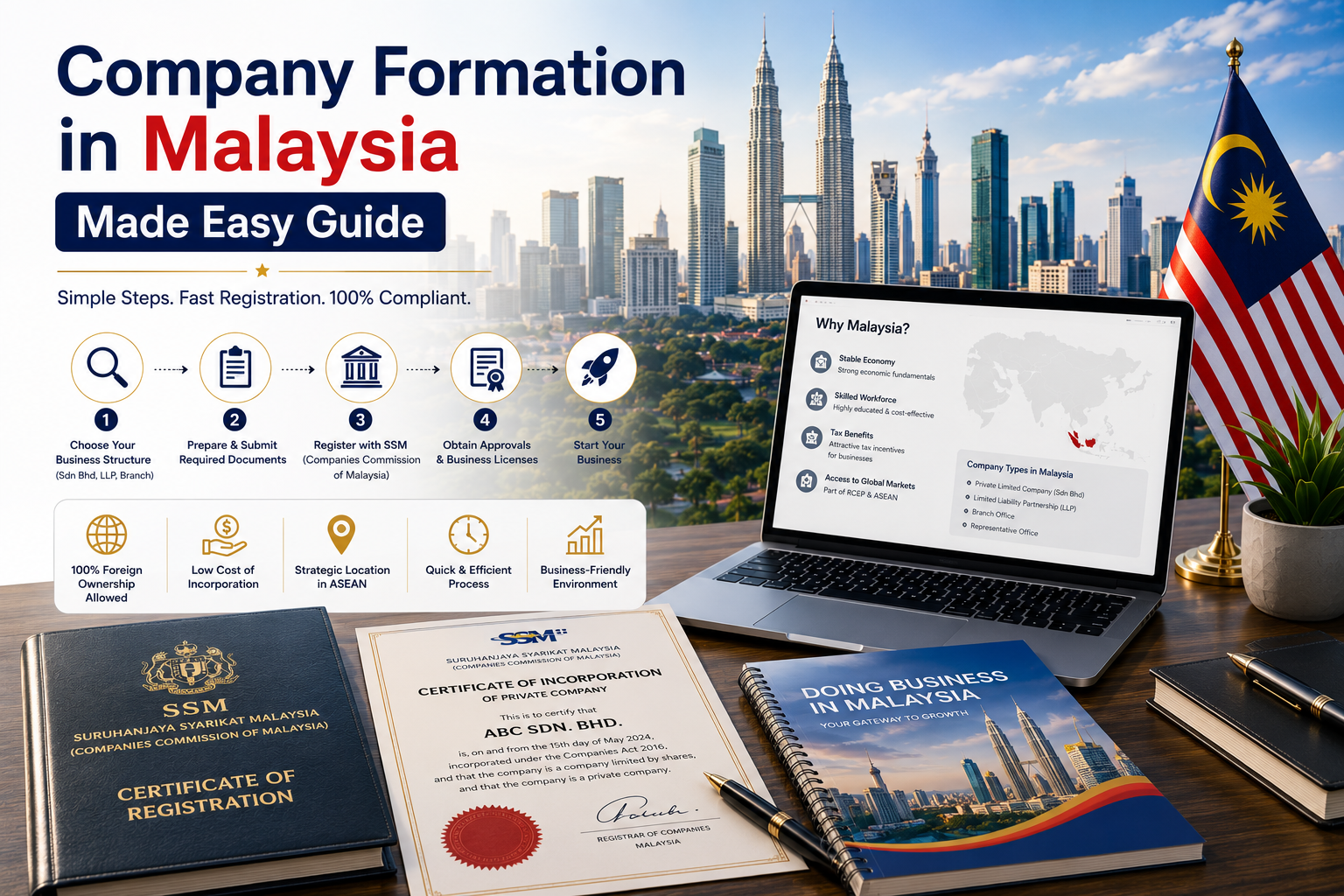

Malaysia has quietly been one of Southeast Asia’s most efficient places to register a company for years, and the digitalization of its registration system has only widened that lead. The Companies Commission of Malaysia, known as SSM, runs the entire incorporation process through its MyCoID portal, and for a well-prepared applicant, the difference between “easy” and “frustrating” here comes down almost entirely to how much homework you do before you submit anything, not how complicated the system itself is.
The Sdn Bhd Is the Obvious Starting Point
Nearly every foreign investor ends up forming a Sdn Bhd company formation in Malaysia private limited company, short for Sendirian Berhad. It’s the structure banks trust, investors expect, and the one that scales cleanly if you eventually want to raise capital or bring on partners. Foreigners can own 100% of a Sdn Bhd in most industries, including consulting, technology, e-commerce, and professional services, with a shorter list of regulated sectors — banking, telecommunications, and a handful of others — carrying ownership restrictions or requiring additional licensing. The legal minimum paid-up capital is a token RM1, though in practice, banks and immigration authorities expect a more realistic figure, particularly if you’re planning to apply for an Employment Pass down the line.
The One Requirement That Surprises Most Foreign Founders
Here’s the detail that catches people off guard: every Sdn Bhd needs at least one director who ordinarily resides in Malaysia, generally defined as someone spending at least 182 days a year in the country. If you don’t have a Malaysian partner or co-founder who fits that description, you’ll need to either relocate yourself under a long-term visa or engage a professional resident director service — a common and entirely normal arrangement for foreign-owned companies, but one worth planning for early rather than discovering mid-application.
What Actually Happens During Registration
Once your structure and director situation are sorted, the process itself moves quickly. You’ll search and reserve your company name through MyCoID — having two or three backup names ready avoids losing time if your first choice is taken or contains a restricted word like “Bank” or “National.” From there, you submit your incorporation details: directors, shareholders, share capital, and a business activity description aligned with Malaysia’s MSIC classification codes, which matters more than it sounds, since vague or mismatched activity descriptions are one of the most common causes of manual review and delay. With complete, accurate documentation, SSM typically issues the Notice of Registration within one to three working days.
Registered Doesn’t Mean Ready to Trade
Getting your Notice of Registration is a real milestone, but it’s not the finish line. Within 30 days, you’re legally required to appoint a licensed company secretary — a mandatory role under the Companies Act 2016, not an optional add-on, and most foreign-owned companies engage one from day one since they also typically provide the registered office address. From there, opening a corporate bank account is usually the longest remaining step, comply globally often taking one to two weeks on its own, and full operational readiness bank account active, tax file number registered with LHDN, ready to invoice — typically lands somewhere between two and four weeks after incorporation, occasionally longer if bank compliance checks run slow.
The Compliance Detail That’s New in 2026
One requirement that didn’t exist a few years ago now shapes how new companies set up their invoicing from day one: Malaysia’s e-invoicing mandate. As of 2026, any single transaction over RM10,000 requires an individual e-invoice regardless of company turnover, and businesses earning above RM1 million annually face broader mandatory e-invoicing requirements, with the threshold continuing to phase down for smaller businesses through 2027. New companies are generally better off choosing accounting software with built-in e-invoicing compliance from the start, rather than retrofitting it once the business is already operating.
Why “Easy” Genuinely Fits, With the Right Preparation
Malaysia’s registration system has earned its efficient reputation honestly — a complete, well-prepared Sdn Bhd application really can be approved within one to three working days, and the whole process from engagement to a fully operational company often wraps up within two to four weeks. What separates the founders who experience it that way from the ones who don’t usually comes down to three things: resolving the resident director question before filing, writing a precise business activity description instead of a vague one, and starting bank account conversations early rather than waiting until incorporation is complete. Handle those three details up front, and Malaysia’s process lives up to its reputation as one of the more genuinely straightforward company formation systems in the region.