

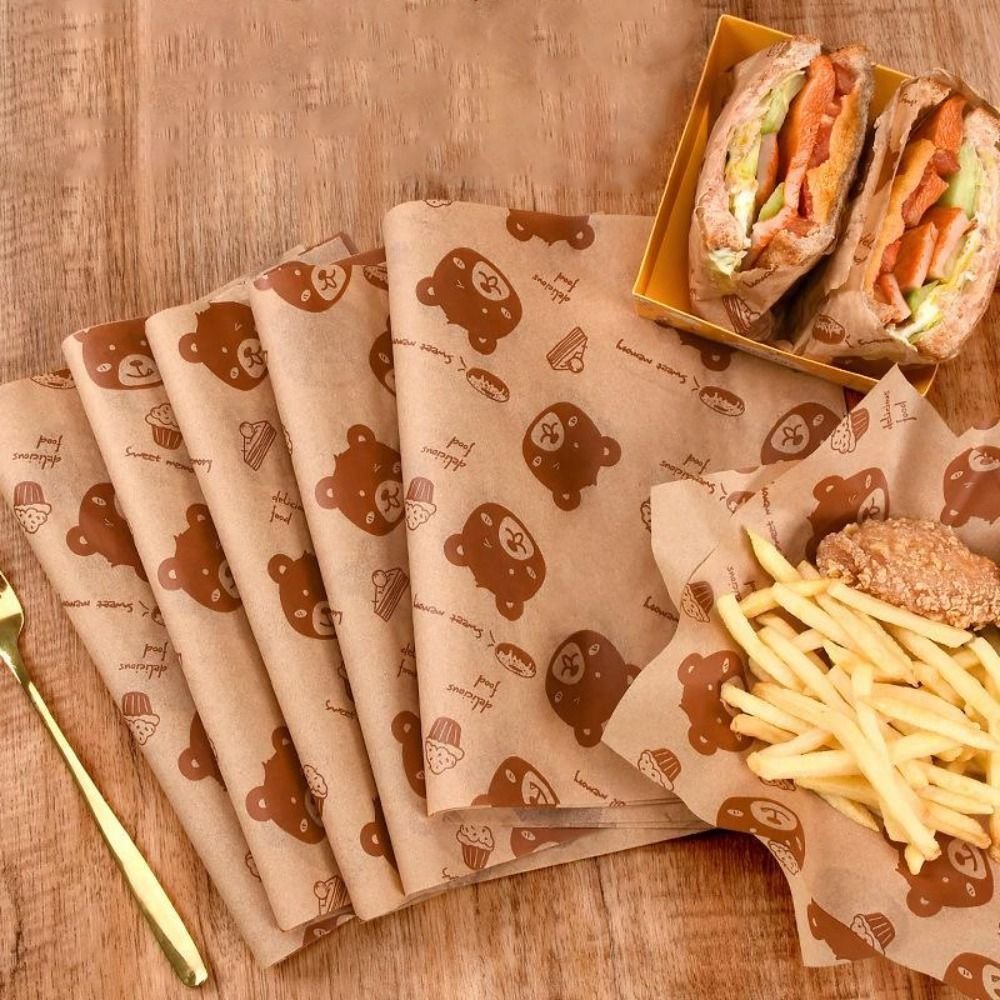

Food packaging plays an important role in how customers experience a restaurant, café, bakery, deli, or takeaway business. Although the primary purpose of packaging is to protect food, it can also contribute to presentation, cleanliness, and brand recognition.
For food businesses, paper wraps and liners need to provide practical performance while looking attractive. The right material can help manage grease and moisture while making sandwiches, burgers, pastries, fries, and other menu items easier to serve. Modern suppliers also offer customized sizes, printed designs, and different formats to suit individual business requirements.
Custom Wax Paper with Logo gives businesses a way to combine food protection with professional branding. Logos, colors, patterns, slogans, and other artwork can be printed onto the paper, turning an everyday food wrapper into another point of contact between a business and its customers.
At the same time, businesses looking for a versatile wrapping material can consider Custom Greaseproof Paper for products that require resistance to oil and moisture. Depending on the supplier and specification, these papers can be produced as sheets or rolls and customized for different food-service applications.
Why Custom Food Paper Matters
Packaging is often one of the first things customers see when receiving their food. A neatly wrapped sandwich or professionally lined food basket can create a stronger impression than food served in plain, unbranded paper.
Printed packaging also keeps the business name visible throughout the customer experience. A repeating logo or recognizable pattern can help customers remember where their meal came from and can reinforce the visual identity of a restaurant.
This is especially valuable for businesses that rely on takeaway orders. When customers carry branded packaging outside the restaurant, the design can provide additional visibility for the business without requiring a separate advertising campaign.
Understanding Wax and Grease-Resistant Paper
Wax-coated food paper is designed to provide a barrier against moisture and light grease. It can be used for wrapping food, lining baskets and trays, separating food products, and presenting takeaway meals. Some current suppliers offer wax paper in white and kraft options, with customized dimensions and food-safe printing.
Greaseproof paper is another popular choice for food businesses. Its grease-resistant properties make it useful for oily, buttery, or saucy menu items. Available specifications can include different paper weights, sheet sizes, roll widths, and printing treatments depending on the supplier.
The best choice depends on the food application. Businesses should consider how much grease or moisture the product contains, whether the paper will directly contact the food, and how long the food will remain wrapped before consumption.
Custom Printing and Branding Options
One of the biggest advantages of customized food paper is the ability to print a business identity directly onto the packaging. A company can use its logo, brand colors, illustrations, slogans, or repeating patterns to create a recognizable appearance.
Printing options vary between manufacturers. Some suppliers offer one-color, two-color, four-color, CMYK, or Pantone-based printing. Custom dimensions are also commonly available, allowing businesses to select paper that fits their products instead of relying entirely on standard sizes.
A simple repeating logo can create a clean and professional appearance. Restaurants wanting a more distinctive design can combine their logo with illustrations, decorative patterns, or brand-specific graphics.
Before production, businesses should review a digital proof carefully. Checking logo size, positioning, colors, spelling, and pattern repetition can prevent expensive mistakes and ensure that the final paper matches the intended brand identity.
Choosing the Right Paper Format
Food paper can be supplied in different formats depending on how it will be used. Pre-cut sheets are convenient for wrapping individual products, lining baskets, and placing beneath food on trays.
Rolls can be useful for businesses that need flexible lengths or handle large volumes of food. Some manufacturers provide both sheets and continuous rolls in custom dimensions.
Businesses should select a format that fits their daily workflow. A fast-food restaurant serving hundreds of burgers may benefit from standardized sheets, while a bakery or deli with products of different sizes may prefer a roll that can be cut according to individual requirements.
Correct sizing can also reduce waste. A sheet that is too large may require excessive folding, while one that is too small may fail to provide adequate coverage.
Applications for Restaurants and Food Businesses
Customized food paper has applications across many parts of the food industry. Restaurants can use it for burgers, sandwiches, wraps, fried chicken, hot dogs, and other takeaway products.
Food trucks can use branded sheets as burger wraps or basket liners, creating attractive packaging without relying on expensive rigid containers. Cafés and bakeries can use smaller sheets for pastries, cookies, sandwiches, and other counter-service products.
Deli businesses can use printed paper for sandwiches, cheeses, prepared foods, and takeaway meals. Catering companies can also benefit from consistent branded packaging because it helps create a coordinated appearance across different events.
Suppliers currently market customized food papers for restaurants, food trucks, bakeries, delis, and other food-service operations, with options including sheets, rolls, tray liners, and wrapping formats.
Food Safety and Material Selection
Food businesses should pay close attention to material suitability when ordering customized packaging. Custom Greaseproof Paper with Logo intended for direct food contact should be appropriate for the intended application, and buyers should request documentation or certifications from suppliers when necessary.
Printing inks are another consideration. Suppliers of food packaging commonly offer food-safe inks designed for their printed paper products. Material specifications can also vary significantly between manufacturers, so businesses should avoid choosing packaging based solely on appearance or price.
It is useful to request samples before committing to a large production run. Testing the paper with actual menu items can help determine whether it handles grease, moisture, heat, sauces, and normal handling effectively.
Businesses should also check whether the paper is intended for specific conditions such as microwave or freezer use rather than assuming that every food paper has the same capabilities.
Ordering Customized Paper in Bulk
For businesses with regular packaging requirements, ordering larger quantities can simplify inventory management and provide consistency between orders. Wholesale production can also be useful for restaurants with multiple locations or food brands with high daily packaging usage.
However, minimum order quantities vary significantly between suppliers. Some manufacturers advertise low minimums, while others focus on larger commercial production runs. Current supplier offerings show a wide range of order quantities and production options.
When comparing suppliers, businesses should consider more than the price per sheet. Paper weight, printing quality, material suitability, dimensions, minimum order quantity, production time, shipping, and artwork support can all affect the overall value.
A reliable supplier should also communicate clearly about specifications and provide an opportunity to approve artwork before production begins.
Creating Better Food Presentation
The right food paper can make everyday service look more polished without requiring complicated packaging. A clean design, appropriate paper size, and consistent branding can make burgers, sandwiches, pastries, and other products look more appealing.
The strongest packaging designs usually support the overall brand rather than competing with the food. Consistent colors and logos across paper, boxes, bags, cups, and labels can create a recognizable identity that customers associate with the business.
Ultimately, customized food paper offers a practical combination of protection, presentation, and marketing. By choosing the right material, format, printing style, and quantity, restaurants and food businesses can create packaging that supports efficient service while giving customers a more memorable experience.