


Ask five installers what a solar permit costs and there’s a good chance you’ll get five different numbers — not because anyone’s wrong, but because Solar Permit Design pricing depends on variables that have nothing to do with the panels themselves. System size matters. So does the state, the roof type, and whether a structural engineer needs to sign off.
That range confuses a lot of homeowners comparing quotes, and it trips up newer contractors trying to price a job accurately. A flat “permit fee” line item hides a lot of moving parts: the jurisdiction’s own filing fee, the engineering labor to draft the plan set, and any specialty documentation a particular roof or system size might require.
Contractors offering residential solar design services across the United States deal with this constantly, since pricing a permit package accurately means understanding which of these variables actually apply to a specific project rather than quoting a generic average that doesn’t hold up once the real details come in.
What’s Included in the Cost of Solar Permit Design
Solar Permit Design cost typically breaks into two separate categories that get lumped together in casual conversation but are actually billed differently.
The jurisdiction’s filing fee is the amount the local building department charges to process the permit application itself, set by that specific city or county and often based on system size or project valuation. The engineering and drafting cost is separate — this covers producing the actual plan set, including the site plan, one-line diagram, structural calculations, and any PE stamp the project requires.
A homeowner comparing two quotes side by side sometimes sees one that looks cheaper simply because it doesn’t clearly break out these two pieces, or because it assumes a jurisdiction’s filing fee that turns out to be different from what the actual project location charges.
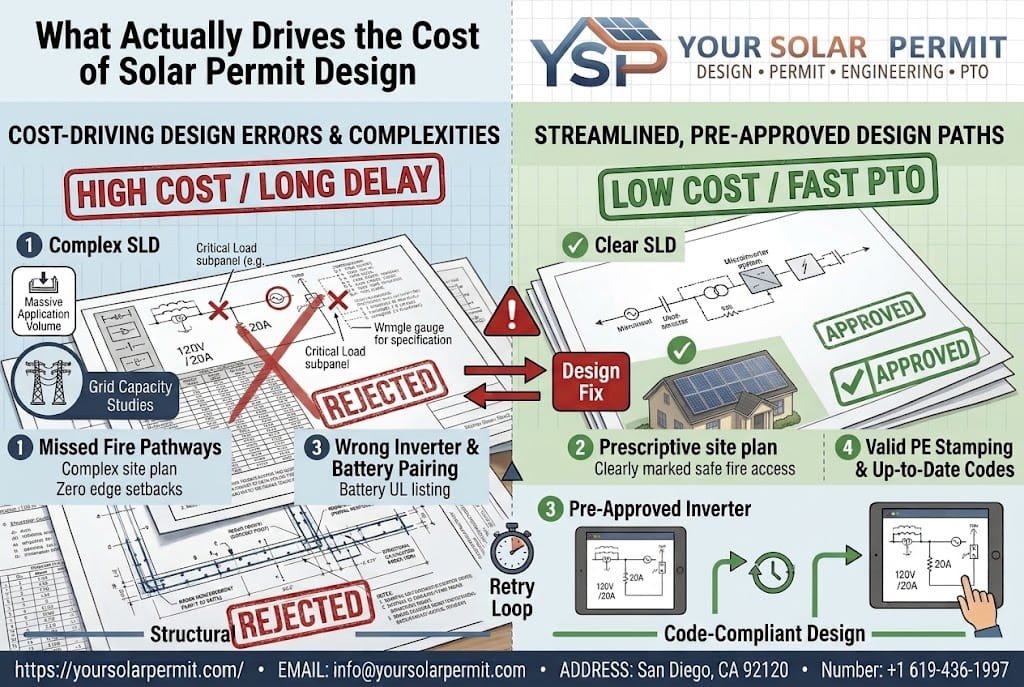
There’s a third, less obvious cost that rarely shows up as its own line item: revision fees. A jurisdiction that requires a resubmission after an initial rejection sometimes charges an additional review fee on top of the original filing cost, which means a plan set that gets it right the first time doesn’t just save time — it can genuinely save money too.
Why Solar Permit Design Costs Vary So Much by State and System Size
Jurisdiction filing fees alone can differ by a wide margin between a small rural county and a major metro building department, and neither number reflects the quality of the engineering behind the plan set — it’s simply what each government office has set as its own fee schedule.
System size affects the engineering side of the cost more directly. A larger array generally means more structural calculation work, potentially more racking zones to document, and sometimes additional interconnection paperwork for a bigger export capacity. Commercial and industrial systems carry this further, often requiring a level of structural and electrical detail that a small residential rooftop simply doesn’t need.
Roof type and condition add another variable. An older roof, an unusual structure, or a roof requiring a PE stamp all add engineering time that a standard, newer roof with a straightforward attachment method wouldn’t need. And here’s the thing — two homes with identical solar arrays can end up with meaningfully different Solar Permit Design costs purely because of what’s underneath the panels, not what’s on top of them.
Battery storage, when it’s part of the project, adds its own cost layer on top of the base solar permit price. A storage-paired submission usually needs additional fire clearance documentation and a separate electrical schematic, which means the engineering time — and the quoted price — for a solar-plus-battery permit tends to run higher than solar alone, even before accounting for the battery equipment cost itself.
The Benefits of Budgeting for Solar Permit Design Early in a Project
Getting an accurate permit cost estimate before finalizing a project budget avoids the awkward mid-project conversation where a customer learns the permit line item was underquoted.
Contractors who ask upfront about roof age, system size, and any known local requirements — rather than quoting a flat average permit cost across every job — give customers a number that actually holds up once the plan set gets drafted. That accuracy reduces disputes later and keeps a project’s overall margin from getting eaten by an unexpected structural engineering fee discovered partway through.
There’s a competitive advantage here too. A contractor who can explain clearly why one project’s permit costs more than another — a PE stamp requirement here, a higher jurisdiction filing fee there — builds more trust with a comparison-shopping customer than one who simply quotes a single number without context.
Residential Solar Design Services Pricing vs Commercial Solar Permit Design Costs
Residential solar design services generally cost less than commercial Solar Permit Design work, mostly because the scope is narrower and more standardized across similar projects.
A typical single-family residential job involves one roof, one utility meter, and a fairly predictable set of documentation requirements, which keeps engineering time — and therefore cost — more consistent from project to project. Commercial and industrial work involves larger structures, more complex load paths, and often multiple stakeholders reviewing the same submission, all of which add engineering hours that show up in the final price.
Ground-mount and carport systems sit somewhere in between, since they avoid some of the roof-specific complexity but add site civil considerations — drainage, grading, access requirements — that a straightforward rooftop residential job doesn’t have to account for.
Practical Steps to Avoid Paying More Than Necessary for Solar Permit Design
A few habits keep permit costs from running higher than a project actually requires.
Confirm the specific jurisdiction’s filing fee before quoting a customer, rather than relying on an average from previous projects in a different county, since fee schedules can differ significantly even between neighboring jurisdictions. Ask early whether the specific roof or system size is likely to trigger a PE stamp requirement, since building that cost into the original quote avoids a surprise price increase discovered mid-project.
Complete permit plan sets built around a jurisdiction’s actual requirements — not a generic national template padded with unnecessary documentation — keep drafting time, and therefore cost, closer to what a specific project genuinely needs. Bundling routine documentation that doesn’t apply to a straightforward residential job, just to reuse a standard commercial-grade package, tends to increase the price without adding real value to the submission.
Not every cost variable is avoidable, either. A jurisdiction’s filing fee and a genuinely required PE stamp aren’t places to cut corners, since skipping either one to save money leads to a rejection that costs more time and money than the original fee would have.
Reviewing past project costs by jurisdiction, rather than relying on a single company-wide average, also helps a contractor spot which markets consistently run higher and price accordingly from the start, instead of discovering the pattern one underquoted job at a time.
Common Cost Mistakes Contractors Make With Solar Permit Design
A handful of pricing mistakes come up again and again.
Quoting a flat permit cost across every project, regardless of roof type or jurisdiction, is probably the most frequent one, and it’s exactly what leads to underquoted jobs that eat into margin once the real requirements come in. Assuming a generic plan set template will satisfy every AHJ is another repeat offender — cutting drafting costs this way often backfires into a rejection and a resubmission that costs more in labor than a properly customized package would have upfront.
Failing to separate the jurisdiction’s filing fee from the engineering cost when quoting a customer is a slower-burning problem, since it makes it hard to explain a price difference later if either component changes. And skipping a PE stamp to lower the quoted price, when the local jurisdiction actually requires one, remains one of the costliest shortcuts on this list, since it virtually guarantees a rejection and a second round of engineering fees.
There’s a longer-term cost to underpricing too, beyond the immediate resubmission fee. A contractor known for consistently underquoted permits ends up training customers to expect a number that rarely holds, which makes every future quote harder to defend — even the accurate ones.
How Your Solar Permit Prices Solar Permit Design for Contractors
Your Solar Permit prices Solar Permit Design based on the actual scope of each project — system size, roof type, and jurisdiction requirements — rather than a flat rate that doesn’t reflect what a specific submission needs.
That means residential and commercial contractors get a quote built around what their project genuinely requires, whether that’s a straightforward rooftop package or a more involved commercial submission with PE-stamped structural calculations. It also means permit plan sets are drafted to the specific jurisdiction’s actual requirements the first time, avoiding the added cost of a resubmission caused by a generic, one-size-fits-all template.
The goal is pricing that’s transparent enough for a contractor to explain to their own customer, not a number that hides how the cost was actually built.
That transparency matters more than it might seem at first. A customer who understands why one project costs more than another rarely pushes back on the number — the pushback almost always comes when a price feels arbitrary, not when it’s clearly tied to something specific about their roof, their location, or their system size.
Frequently Asked Questions About Solar Permit Design Costs
How much does a solar permit cost?
Solar permit costs vary widely by jurisdiction, system size, and whether a PE stamp is required, so it’s best confirmed against a current quote rather than a fixed number. The total typically includes both a jurisdiction filing fee and the engineering cost to draft the plan set.
Does permit cost include the engineering plan set?
Not always — some quotes separate the jurisdiction’s filing fee from the engineering and drafting cost, while others bundle them into a single line item. Asking for a breakdown helps clarify what’s actually being paid for and why costs might differ between quotes.
Why do solar permit fees vary so much between cities?
Each jurisdiction sets its own filing fee schedule independently, often based on system size or project valuation, which means neighboring cities or counties can charge noticeably different amounts for the same size project. This variation reflects local government fee-setting, not the quality of the engineering behind the plan set.
Is solar permit design cost included in installation quotes?
It depends on the contractor — some installers roll permit costs into the overall installation price, while others itemize it separately. Asking directly whether the quote includes filing fees and engineering costs avoids confusion when comparing quotes from different companies.
Do commercial solar permits cost more than residential ones?
Generally yes, since commercial projects involve larger structures, more complex load paths, and often more detailed interconnection documentation than a typical residential rooftop system. The added engineering time required for commercial-scale projects is usually reflected in a higher permit design cost.
Can I get a cheaper solar permit design by using a generic template?
Not reliably — a generic template that doesn’t account for a specific jurisdiction’s requirements often leads to a rejection, which adds a resubmission cost that outweighs any initial savings. A plan set built around the actual jurisdiction and project details from the start tends to be cheaper in the long run than repeated corrections.