

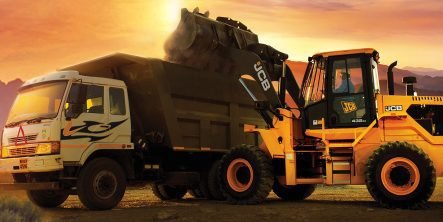

Spend enough time around construction yards, quarries, or logistics hubs in the UAE, and you’ll notice a particular machine that never seems to stop moving. It scoops, turns almost on the spot, carries its load a short distance, dumps it, and pivots back for more — all with a distinctive bend in the middle of its body as it steers. That’s the articulated wheel loader UAE, and while it rarely gets the attention that towering cranes or excavators do, it’s often the machine quietly keeping a site’s material flow running on schedule.
What Makes the “Articulated” Part Worth Talking About
Most people who aren’t in construction assume a loader steers the way a car does — front wheels turning while the chassis stays rigid. Articulated loaders work differently. The frame itself bends at a central pivot point, so the whole machine essentially folds in the middle when turning. This gives it a dramatically tighter turning radius than a rigid-frame machine of similar size, which matters enormously on cramped urban sites, warehouse yards, or quarry faces where space to manoeuvre is limited.
In a market like the UAE, where a lot of construction happens on tight urban plots squeezed between existing roads and neighbouring developments, that manoeuvrability isn’t a minor convenience — it’s often the difference between a machine being usable on a given site at all or not.
Built for Repetition, Not Just Power
Wheel loaders are, at their core, material-handling machines. Their job is repetitive by design: load, carry, dump, repeat, often hundreds of times in a single shift. What separates a good loader operation from an inefficient one usually isn’t raw horsepower; it’s cycle time — how quickly and smoothly the machine can complete each loop.
This is part of why loader selection in the UAE tends to focus heavily on bucket capacity matched to the specific material being handled. Aggregate, sand, and demolition debris all have different densities and handling characteristics, and a bucket sized for one can be inefficient or even risky for another. Contractors moving large volumes of sand for land reclamation or infrastructure fill, for instance, often prioritise different loader specifications than those handling crushed rock at a quarry.
Tyres, Terrain, and the UAE’s Particular Challenges
Unlike crawler machines, wheel loaders run on tyres, which brings its own set of considerations in this environment. Loose sand, sharp aggregate, and hot asphalt surfaces all accelerate tyre wear in ways that don’t show up as quickly in cooler, softer-ground markets. Operators and fleet managers here tend to pay close attention to tyre selection — choosing compounds and tread patterns suited to abrasive material — because tyre replacement is one of the higher ongoing costs in loader operation.
Heat is another factor that shapes how these machines are used day to day. Hydraulic fluid, engine coolant, and even tyre pressure all behave differently under sustained high temperatures, which is why maintenance schedules in the UAE often run tighter than manufacturer defaults suggest for temperate climates. Fleet operators who’ve worked here long enough tend to build in extra inspection intervals during the hottest months rather than waiting for a breakdown to signal a problem.
Where These Machines Actually Show Up
It’s easy to think of wheel loaders purely in terms of big infrastructure projects, but their real footprint is broader than that. Quarries and aggregate processing plants across the northern emirates rely on them constantly for stockpile management. Ports and logistics yards use them for bulk material handling. Even municipal operations — waste management, road maintenance depots, landscaping for public parks — depend on smaller loader models for day-to-day tasks that never make headlines but keep cities functioning.
This diversity of use is worth noting because it explains why the loader market here isn’t dominated by a single size class. A quarry operation might run large, high-capacity loaders around the clock, while a landscaping contractor working within a residential community needs something compact enough to navigate narrow access roads without tearing up kerbs or damaging existing infrastructure.
The Operator’s Role Is Easy to Underestimate
Because loader work looks repetitive from a distance, it’s easy to assume the skill required is minimal. In practice, experienced operators develop a feel for bucket fill technique that significantly affects both fuel consumption and cycle efficiency — knowing exactly how to angle and roll the bucket into a pile to get a full load without excessive engine strain, for example. Over a full shift, small inefficiencies in technique compound into real differences in output and running costs.
Site conditions in the UAE add another layer to this. Operators working near excavation edges, close to other machinery, or in low-visibility dust conditions during sandstorms need judgment that goes beyond simply operating the controls competently.
Read Also: Coffee Bean Lab Analysis Equipment by Coffee Pro Direct
A Machine That Earns Its Keep Through Consistency
The articulated wheel loader doesn’t have the visual drama of a crane lifting steel into place or an excavator biting into rock. Its value shows up differently — in how smoothly material moves through a site, how few delays a project experiences waiting on stockpiles, and how well a fleet holds up against the wear that heat, dust, and abrasive terrain inflict over time.
For anyone trying to understand the less visible mechanics behind how quickly things get built and moved in the UAE, it’s worth paying attention to this machine’s quiet, constant work in the background.